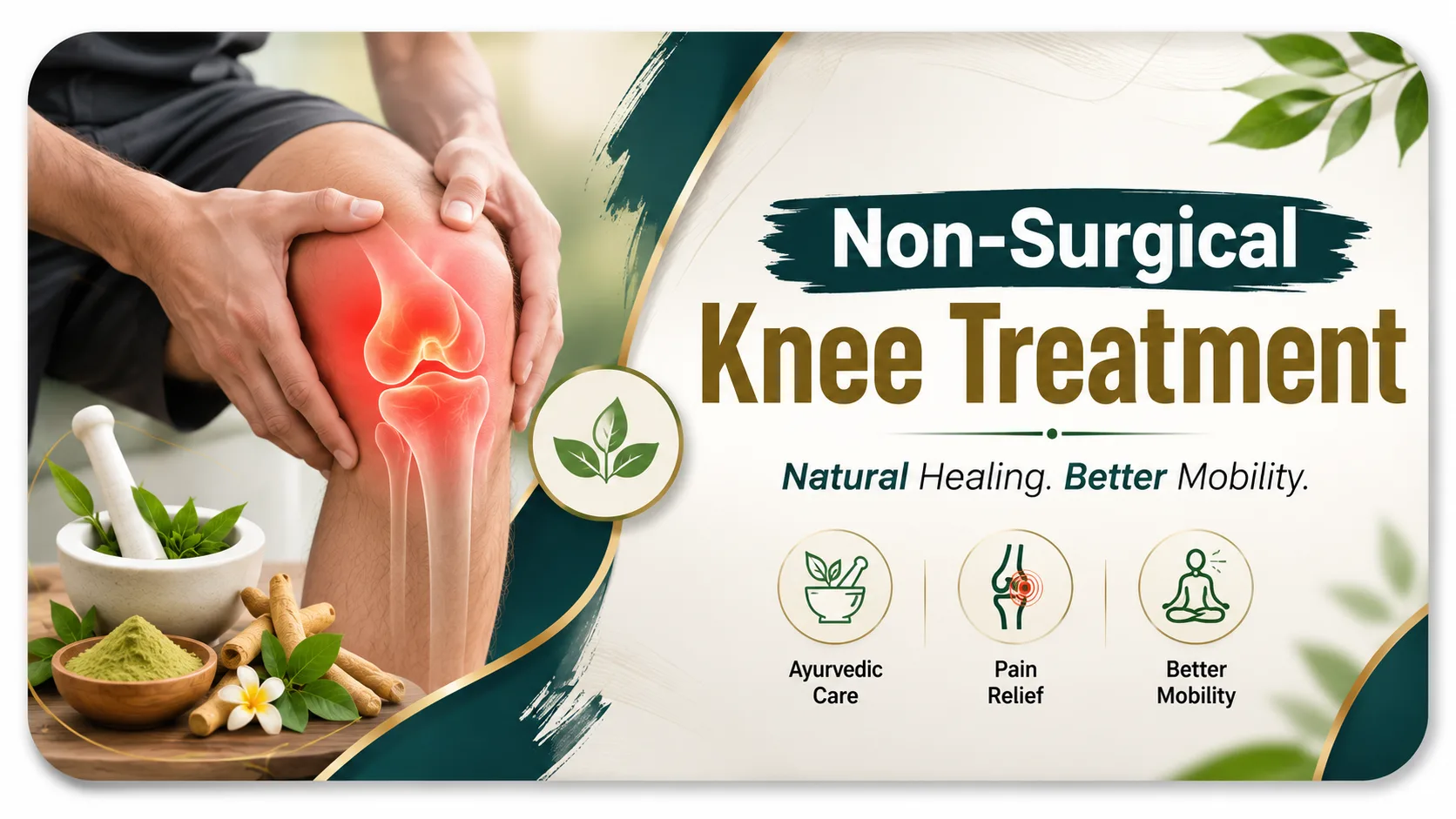
What Is Non-Surgical Knee Treatment? | नॉन-सर्जिकल नी ट्रीटमेंट क्या है?
Non-Surgical Knee Treatment refers to various methods for managing knee pain and improving joint function without surgery. It may include physiotherapy, exercise, weight management, lifestyle changes, and supportive therapies such as Ayurvedic Knee Treatment. The aim is to help reduce discomfort, improve movement, and support overall knee health.
In simple words, घुटने के दर्द को बिना सर्जरी के संभालने की कोशिश ही नॉन-सर्जिकल नी ट्रीटमेंट कहलाती है।
Knee Pain Ko Bina Surgery Manage Karne Ke Approaches | घुटने के दर्द को बिना सर्जरी कैसे मैनेज किया जा सकता है?
Let's be honest; most of us don't think much about our knees until they start hurting.
One day you're walking comfortably through the market, and the next day you're holding the staircase railing like it's your best friend.
The good news is that knee pain can often be managed through a combination of different approaches. Think of it as teamwork. Rather than relying on a single solution, several factors work together to support your knees.
Lifestyle Care | जीवनशैली की देखभाल
Simple daily habits can make a difference. Avoiding unnecessary strain, taking breaks from prolonged sitting, and paying attention to posture may help support knee health.
Exercise | व्यायाम
Movement is important. The right exercises help keep the joint active and strengthen the muscles that support the knee.
Physiotherapy | फिजियोथेरेपी
Physiotherapy focuses on improving strength, flexibility, and movement. It can also help people learn better ways to move without putting extra pressure on the knees.
Weight Management | वजन प्रबंधन
Our knees carry our body weight all day long. Naturally, extra weight means extra pressure on the joints.
मतलब, थोड़ा सा वजन कम करना भी कई लोगों के लिए घुटनों पर पड़ने वाले दबाव को कम करने में मदद कर सकता है।
Ayurvedic Therapies | आयुर्वेदिक उपचार
Many people also explore Ayurvedic approaches alongside lifestyle changes. These therapies are traditionally used to support joint health and overall well-being.
कई बार घुटनों को राहत देने के लिए किसी बड़े बदलाव की नहीं, बल्कि रोज़मर्रा की छोटी अच्छी आदतों की ज़रूरत होती है।
When Is Non-Surgical Knee Treatment Considered? | नॉन-सर्जिकल नी ट्रीटमेंट कब विचार किया जाता है?
A common question people ask is:
"How do I know if non-surgical treatment might be suitable for me?"
The answer depends on your symptoms, medical reports, and your doctor's advice. However, these approaches are often considered when knee problems are in the mild to moderate stage.
You may discuss non-surgical options with your healthcare provider if you have:
- Mild knee pain
- Moderate osteoarthritis
- Early cartilage wear
- Persistent joint stiffness
- Swelling around the knee
- Difficulty moving comfortably
Many people also choose these options when they are not ready for surgery and want to explore other treatment paths first.
Common symptoms often include:
- Chronic knee pain
- Knee discomfort
- Joint stiffness
- Reduced mobility
- Degenerative knee condition
The earlier knee problems are identified, the more treatment options are usually available.
Common Causes of Knee Pain | घुटनों के दर्द के सामान्य कारण
Before talking about treatment, it helps to understand why the knee is hurting in the first place.
After all, your knee isn't hurting just to make life difficult. There is usually an underlying reason.
| Condition | Description |
| Osteoarthritis | Wear and tear of the knee joint over time |
| Arthritis | Inflammation affecting the joints |
| Cartilage Damage | Breakdown of the cushioning tissue between bones |
| Meniscus Injury | Injury to the soft tissue inside the knee |
| Obesity | Extra weight increases pressure on the knee joint |
Think of the knee joint like the suspension system of a car. When the cushioning starts wearing down, every bump
feels a little more noticeable.
Types of Non-Surgical Knee Treatment | नॉन-सर्जिकल नी ट्रीटमेंट के प्रकार
When it comes to managing knee pain, there is rarely one magic solution. Usually, a combination of different approaches is considered.
Physiotherapy | फिजियोथेरेपी
Physiotherapy is often one of the first recommendations for people dealing with knee pain.
The focus is usually on:
- Improving flexibility
- Strengthening muscles
- Supporting balance
- Improving movement patterns
The stronger and more stable the muscles around the knee become, the better support the joint may receive.
Exercise Therapy | एक्सरसाइज थेरेपी
Our knees do not work alone. The muscles around them help absorb stress and support movement.
When these muscles become weak, the knee joint may end up handling more pressure than it should.
Some commonly recommended low-impact activities include:
- Walking
- Swimming
- Cycling
- Stretching exercises
- Strength-building exercises
The best exercise plan depends on the individual's condition and should ideally be guided by a professional.
Weight Management | वजन प्रबंधन
Weight plays a bigger role in knee health than many people realize.
Every step you take places pressure on your knees. When body weight increases, that pressure increases too.
That's why weight management is often an important part of many non-surgical treatment plans.
Lifestyle Modifications | जीवनशैली में बदलाव
Sometimes small changes can make daily life more comfortable.
Examples include:
- Wearing supportive footwear
- Avoiding prolonged squatting
- Taking regular movement breaks
- Avoiding repetitive strain
- Using proper sitting posture
Small habits may not seem exciting, but they often add up over time.
Ayurvedic Knee Treatment | आयुर्वेदिक घुटना उपचार
Many individuals also explore Ayurvedic Knee Treatment as part of a holistic approach.
Ayurveda focuses on balancing lifestyle, diet, and traditional therapies that support overall joint health rather than looking at the knee in isolation.
Ayurvedic Non-Surgical Knee Treatment | आयुर्वेदिक नॉन-सर्जिकल नी ट्रीटमेंट
In Ayurveda, knee-related issues such as stiffness, discomfort, and wear-and-tear changes are often associated with Sandhigata Vata (संधिगत वात).
According to Ayurvedic principles, this condition is linked with increased dryness and reduced lubrication in the joints, which may affect movement and comfort.
Several traditional therapies are commonly discussed in Ayurvedic knee care.
Janu Basti | जानु बस्ती
Janu Basti is one of the best-known Ayurvedic therapies for knee care.
In this procedure, warm medicated oil is retained over the knee area for a specific period using a specially prepared boundary around the joint.
It is often included in Ayurvedic wellness programs focused on knee health.
Agnikarma | अग्निकर्म
Agnikarma is a traditional Ayurvedic procedure that uses controlled heat application under professional supervision.
It is sometimes recommended based on the individual's condition and treatment goals.
Panchakarma | पंचकर्म
Panchakarma for Knee Pain is often discussed as part of Ayurvedic detoxification and wellness programs.
Depending on the individual, different therapies may be suggested as part of a broader treatment plan.
Ayurvedic Medicines | आयुर्वेदिक औषधियां
Ayurvedic practitioners may recommend herbal formulations based on individual assessment.
Traditionally used herbs may include:
- Guggulu
- Shallaki
- Ashwagandha
The choice of medicines depends on the person's symptoms, constitution, and overall health.
Diet & Lifestyle Guidance | आहार और जीवनशैली संबंधी मार्गदर्शन
Diet plays an important role in Ayurveda.
Patients are often advised to focus on:
- Freshly prepared meals
- Balanced nutrition
- Proper sleep
- Regular routines
- Joint-friendly lifestyle habits
आयुर्वेद में माना जाता है कि सही आहार और सही दिनचर्या, दोनों मिलकर शरीर को बेहतर तरीके से काम करने में मदद करते हैं।
Non-Surgical Treatment for Osteoarthritis | ऑस्टियोआर्थराइटिस के लिए नॉन-सर्जिकल उपचार
One of the most common reasons people explore non-surgical care is osteoarthritis.
The treatment approach often depends on how much knee degeneration, cartilage loss, or knee joint wear has occurred.
Grade 1 OA | ग्रेड 1 ऑस्टियोआर्थराइटिस
This is usually the earliest stage.
Symptoms may be mild and occasional.
Management often focuses on:
- Exercise
- Weight management
- Lifestyle changes
- Physiotherapy
The goal is generally to support joint health and maintain mobility.
Grade 2 OA | ग्रेड 2 ऑस्टियोआर्थराइटिस
At this stage, symptoms may become more noticeable.
People may experience:
- More frequent pain
- Mild stiffness
- Reduced comfort during activity
A typical Grade 2 OA management plan may include physiotherapy, strengthening exercises, and other supportive treatments.
Grade 3 OA | ग्रेड 3 ऑस्टियोआर्थराइटिस
With Grade 3 OA, knee joint wear and cartilage loss may become more significant.
People often experience:
- More frequent discomfort
- Difficulty with daily activities
- Reduced mobility
Many individuals continue exploring Osteoarthritis Knee Treatment options while discussing long-term plans with their healthcare provider.
Can Non-Surgical Treatment Help Avoid Knee Replacement? | क्या नॉन-सर्जिकल उपचार घुटना प्रत्यारोपण से पहले एक विकल्प हो सकता है?
This is probably the most common question people ask.
"Can I avoid knee replacement surgery?"
The honest answer is that it depends on the individual situation.
It is important to understand that non-surgical treatments do not claim to completely restore severely damaged cartilage or reverse advanced structural changes.
However, some patients explore non-surgical options before considering knee replacement, depending on their condition, symptoms, lifestyle, and medical advice.
For people with mild to moderate joint changes, a combination of physiotherapy, exercise, weight management, and supportive therapies may help them manage symptoms and maintain mobility.
The right decision should always be based on professional medical evaluation.
Benefits of Non-Surgical Knee Treatment | नॉन-सर्जिकल नी ट्रीटमेंट के संभावित लाभ
Many people prefer exploring non-surgical approaches first because of the following potential benefits:
- No surgical incision
- Personalized care
- Recovery support
- Mobility-focused approach
- Focus on day-to-day function
- May be combined with lifestyle improvements
- Can often be adjusted according to individual needs
For many patients, the biggest advantage is being able to focus on improving movement and comfort without immediately considering surgery.
Who May Be a Candidate? किन लोगों के लिए यह उपचार विकल्प हो सकता है?
Non-surgical treatment options are often explored by people who experience:
- Knee pain
- Osteoarthritis
- Early cartilage damage
- Joint stiffness
- Swelling around the knee
- Reduced mobility
- Chronic knee discomfort
- Mild to moderate degenerative knee conditions
You may also consider discussing these options with a healthcare professional if your symptoms affect daily activities, but surgery has not been recommended yet.
घुटनों की देखभाल समय पर शुरू करना ही समझदारी है।
The earlier knee problems are addressed, the easier it may be to explore different treatment options and build habits that support long-term joint health.
Remember, every knee is different. What works for one person may not be the best option for another. That is why proper diagnosis and professional guidance remain important when choosing the most suitable treatment approach.
FAQ
What is non-surgical knee treatment?
It is a treatment approach that relieves knee pain and improves mobility without surgery.
Can knee pain be treated without surgery?
Yes, many cases of knee pain can be managed with therapies, exercises, and lifestyle changes.
Can osteoarthritis be managed without surgery?
Yes, non-surgical treatments can help reduce pain and improve joint function in osteoarthritis.
What are alternatives to knee replacement?
Physiotherapy, Ayurveda, medications, weight management, and regenerative therapies are common alternatives.
Is Ayurveda a non-surgical treatment?
Yes, Ayurveda uses natural therapies, herbs, and lifestyle modifications without surgery.
What is Janu Basti?
Janu Basti is an Ayurvedic therapy where warm medicated oil is retained over the knee joint.
What is Agnikarma?
Agnikarma is an Ayurvedic heat-based therapy used to help relieve chronic pain and stiffness.
Which exercises help with knee pain?
Gentle strengthening and stretching exercises like straight leg raises and hamstring stretches can help.
Is walking good for knee pain?
Yes, moderate walking can improve joint mobility and strengthen the muscles around the knee.
How long does non-surgical treatment take?
The duration varies, but many people notice improvement within a few weeks to a few months.