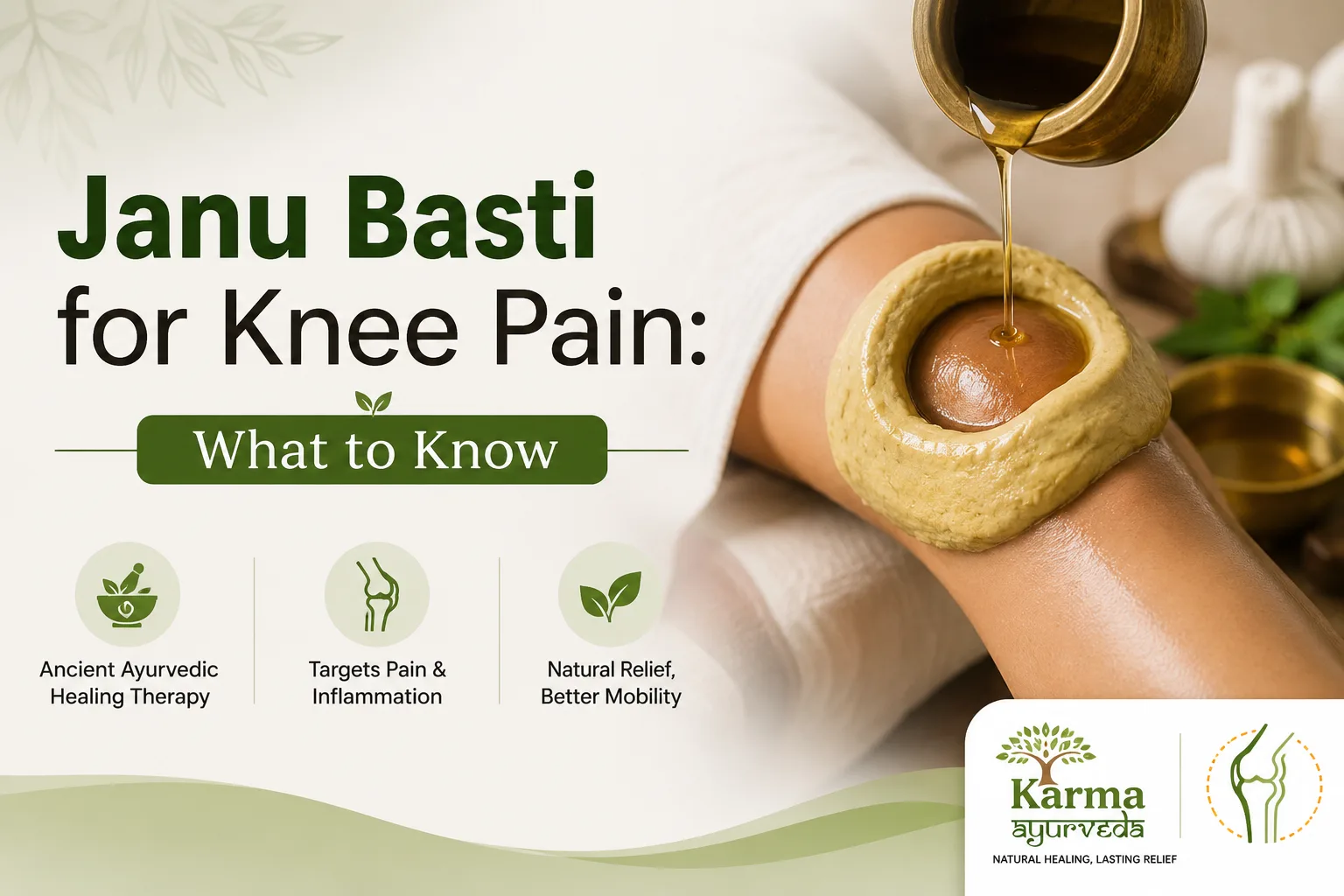
Short answer: yes, Janu Basti actually works for a lot of people, and it works by pooling warm medicated oil over your knee inside a little dough ring for 30-45 minutes so the joint gets properly "re-oiled" instead of grinding away dry. That's the whole trick. Now let me tell you why it's not as woo-woo as it sounds.
Here's the thing nobody tells you about knees: they're basically a hinge that's expected to work flawlessly for eighty-plus years with zero maintenance breaks. No wonder they start protesting somewhere around your 40s. One day you're jogging fine, the next you're standing up from a chair and your knee makes a sound like someone stepping on bubble wrap. If that's you, welcome to the club, and welcome to this blog, because we're going to talk about Janu Basti, one of Ayurveda's oldest answers to exactly this problem.
Ayurveda calls this whole situation Sandhigata Vata; the elderly-onset dryness and degeneration of joints caused by aggravated Vata dosha. Basically, your joint has lost its natural moisture and lubrication, kind of like a car engine that's been running low on oil for way too long. And instead of reaching for a wrench, Ayurveda reaches for a bowl of warm oil.
Okay, But What Does Janu Basti Actually Look Like?
I know, "oil retention therapy" sounds like something out of a spa brochure written by someone who's never actually had knee pain. So let me paint the real picture.
You lie down. A practitioner builds a small circular dam around your kneecap using dough made from black gram flour; genuinely, it looks like they're baking a tiny pie crust directly on your leg. Then warm medicated oil, usually Mahanarayana Taila or Ksheerbala Taila, gets poured into this little pool and topped up to stay warm for the better part of an hour.
That's it. You just lie there while your knee soaks. It's oddly relaxing, honestly, in a "why didn't anyone tell me about this sooner" kind of way.
The logic (called Snehana, or oleation, if you want to sound fancy at dinner parties) is that sustained warmth plus medicated oil improves blood flow to the joint and lets the oil's active compounds actually penetrate the tissue rather than just sitting on the skin like your average massage oil does.
Alright, Does Science Have Anything Nice to Say About This?
I'm not going to just tell you "trust the ancient texts" and move on, because that's not fair to you or your knee. Let's actually look at what's been studied.
A pilot study run through the Journal of Ayurveda and Integrative Medicine had patients undergo Janu Basti with Ksheerbala oil for 21 straight days, followed by a five-week self-massage routine at home, and the pain and stiffness scores came down meaningfully by the end.
Then there's a comparative clinical study published in AYU, a proper peer-reviewed Ayurveda journal, that used the same measurement tools your orthopedist would use; the Visual Analog Scale for pain and the WOMAC index for disability; and tracked patients across 30 days. Both Janu Basti and its cousin therapy, Matra Basti, showed real, measurable improvement.
Another trial went a step further and tested Janu Basti with an added poultice treatment called Upnaha against Janu Basti on its own. Turns out, the combo punch did better than oil alone, which honestly tracks; most good things in life work better as a team effort.
And if you want proof that this isn't just a fringe home remedy anymore, there's a registered randomized controlled trial currently running through the Clinical Trial Registry of India, studying a full multimodal Ayurveda regimen (Janu Basti included) using lab work and imaging, not just "patient said they feel better." That's the kind of scrutiny that should make even the skeptics sit up a little.
None of this makes Janu Basti a magic fix that erases decades of wear and tear. But across study after study, the pattern holds: less pain, better movement, improved WOMAC scores, especially when the osteoarthritis hasn't reached the "let's just replace the whole knee" stage.
Who Should Actually Consider This?
Janu Basti for osteoarthritis tends to work best if:
- You're dealing with early or moderate knee osteoarthritis, not the advanced "bone grinding on bone" stage
- Your knees get worse in cold or rainy weather (classic Vata behavior, apparently)
- You've got that dull, nagging stiffness after sitting or standing too long
- You're looking for a non-surgical knee pain treatment to run alongside physiotherapy, not instead of common sense
If your knee has structural damage, a torn ligament, or you're already staring down a knee replacement conversation with your surgeon, Janu Basti is a supporting player here, not the hero of the story. Please still see your doctor.
Janu Basti vs Your Usual Painkiller: Let's Be Honest About This
| What matters | Janu Basti | Painkillers / NSAIDs |
| How fast it kicks in | Slow and steady, over several sessions | Almost suspiciously fast |
| Side effects | Basically none, unless you count smelling like a sesame field | Stomach trouble, long-term risk with regular use |
| Cost over months | A bit more upfront, evens out | Cheap now, sneaky expensive later |
| Does it fix anything or just mute it | Actually nourishes the joint | Mostly just tells the pain to hush |
| Relaxation value | Genuinely feels like a spa day | Zero. Unless the couch nap counts |
One treats your knee like it's on a wellness retreat. The other treats it like a car alarm you just want to shut off. Depending on the day, you might want both.
A Few Things Worth Knowing Before You Book a Session
Don't try this with a bowl of leftover coconut oil from your kitchen and call it a day; that's not the same thing, no matter how many reels convince you otherwise. Go to someone actually trained in Panchakarma. And go more than once.
Studies that showed real results weren't one-and-done sessions; they ran anywhere from a week to three. Your knee didn't get creaky overnight, so it's not going to un-creak overnight either.
Also, and I say this with love, please still move your body. Gentle strengthening exercises, a bit of weight management if that's relevant to you, and the oil therapy work far better as a package deal than any single piece alone. And if you've got open wounds, skin infections, or a condition like diabetes, talk to your doctor before diving into oil retention therapy, just to be safe.
Key Takeaways
- Janu Basti uses warm medicated oil retained over the knee to ease pain and stiffness tied to Sandhigata Vata, the Ayurvedic term for knee osteoarthritis
- Clinical studies using VAS pain scores and the WOMAC index show real, measurable improvement after a course of sessions
- Works best for mild-to-moderate osteoarthritis, not advanced joint damage
- Mahanarayana Taila and Ksheerbala Taila are the most commonly used oils
- Pairs well with movement, weight management, and proper medical guidance; it's a teammate, not a solo act
FAQs
Does Janu Basti actually help with knee osteoarthritis?
Yes; multiple clinical studies show real drops in pain and stiffness scores after a course of sessions.
How many sessions do you actually need?
Most protocols run 7 to 21 daily sessions, because a single relaxing evening won't undo years of wear and tear.
Is it safe for everyone?
Mostly, yes, but skip it if you've got open wounds or skin infections near the knee, and check with your doctor if you're managing diabetes.
Can this replace knee surgery?
No; it's genuinely helpful for mild-to-moderate cases but isn't a substitute for surgery once the joint damage is severe.
What oil is used during the therapy?
Usually Mahanarayana Taila or Ksheerbala Taila, both picked for their anti-inflammatory and Vata-calming properties.
Disclaimer: This blog is meant for general information only, not medical advice. Knees are personal, complicated things, and yours deserve an actual doctor's opinion; please consult a qualified physician or certified Ayurvedic practitioner before starting Janu Basti or any new treatment.