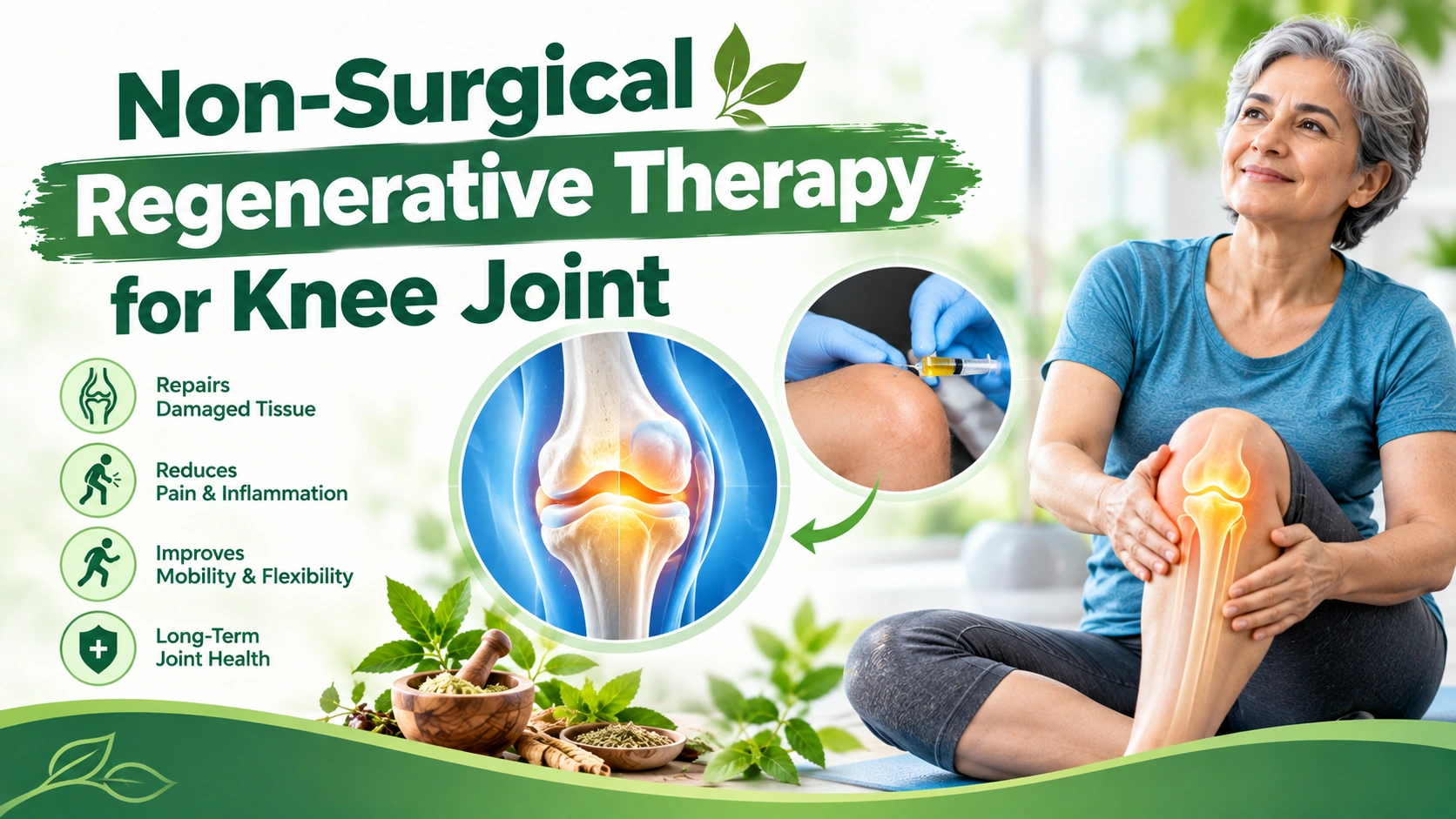
Short answer: it uses stuff already inside your body- your own stem cells or platelets- to actually repair damaged knee cartilage instead of just quieting the pain long enough for you to forget about it. That's the whole idea in two lines. Now let's actually talk about it like normal people.
Because let's be honest, nobody wakes up one day and thinks "you know what, I'd like to learn about cartilage biology today." You end up here because your knee made a sound like a bag of gravel when you stood up from the couch, and suddenly you're twelve tabs deep at 11 pm googling "why does my knee crack" followed shortly by "am I too young for a knee replacement" (you're probably not getting one, calm down).
So, here's the deal with knee regeneration treatment; no lab coat jargon, promise.
Okay But What's Actually Happening in There
Picture your cartilage as the cushioning between two puzzle pieces that were never meant to grind against each other directly. Over time, from injury, age, or that one time you decided a marathon was a good idea with zero training- that cushioning wears thin. Unlike skin or a paper cut, cartilage doesn't heal itself well. It has basically no blood supply, so it just... sits there, slowly getting worse, like a pothole nobody's filling.
This is where stem cell therapy for knees and PRP treatment (platelet-rich plasma, if we're being fancy) come in.
The process, in plain terms:
- Doctors take a small sample from your own body; usually fat tissue or bone marrow
- That sample gets spun and processed to pull out the good stuff: mesenchymal stem cells or concentrated platelets
- That concentrated mix gets injected right into the knee joint
- From there, those cells get to work calming inflammation and nudging cartilage regeneration along
It's not instant, and it's not magic. It's more like hiring a slow but determined contractor who actually shows up and fixes things instead of just painting over the cracks.
Why Not Just Take a Pill and Move On?
Because painkillers and anti-inflammatories are basically doing PR for your knee, not repair work. They make the knee feel better while the underlying damage keeps quietly doing its thing. That's fine for a while; until it isn't. Traditional knee osteoarthritis treatment has leaned heavily on this "manage it" approach for decades, followed eventually by surgery once things get bad enough.
Regenerative treatments try to skip ahead and address the actual damage earlier, which is honestly a nicer plan than waiting until your only options are "live with it" or "replace the whole joint."
Is There Actual Science, or Is This Wellness-Influencer Territory?
Fair to ask, because a lot of "regenerative" buzzwords get thrown around loosely these days. But there's real research here.
One clinical case series on adipose-derived stem cells followed patients who received stem cell and PRP injections into osteoarthritic knees, and their follow-up MRIs actually showed cartilage-like tissue where there wasn't much before, along with better range of motion and less pain. Separately, a comparative study by Koh and colleagues looked at patients getting combined MSC and PRP injections versus PRP alone after knee surgery, and the combo group came out ahead on both function scores and how the knee actually looked during follow-up arthroscopy. A wider review of cartilage repair techniques pulled together multiple trials and found a consistent pattern; patients getting stem cell therapy reported better comfort and showed improved cartilage quality compared to those who didn't.
So no, this isn't just a green juice with a medical costume on. There's a growing pile of actual clinical evidence.
Traditional Treatment vs Regeneration: The Blunt Comparison
| Traditional Treatment | Regeneration Treatment | |
| What it's really doing | Muting the pain signal | Trying to fix the actual damage |
| Recovery vibe | Can be long, especially post-surgery | Usually quicker, way less dramatic |
| Where the "medicine" comes from | Pharmacy shelf | Your own body, doing overtime |
| Commitment level | Ongoing, often forever | Fewer sessions, more targeted |
| What it's best for | Later-stage, more severe damage | Early to moderate wear and tear |
Neither one is "wrong"; they're just solving different problems at different stages.
Who's Actually a Good Fit for This?
Not everyone, and any honest source will tell you that upfront:
- People in the early or moderate stages of knee osteoarthritis
- Athletes or active folks trying to avoid surgery for as long as possible
- Anyone wanting a less invasive option before even considering a knee replacement
- People whose knees have started sounding like a bowl of cereal every time they climb stairs
If you're already at full bone-on-bone, advanced arthritis, this probably won't do the heavy lifting a replacement would. It shines earlier in the process, not as a last resort.
Key Takeaways
- Knee regeneration treatment uses your own stem cells or platelets to repair cartilage, not just numb the pain
- Cartilage barely heals on its own because it has almost no blood supply
- Real clinical studies show pain relief, better function, and MRI-confirmed cartilage changes
- It works best on early to moderate damage, not advanced bone-on-bone arthritis
- It's generally less invasive with a shorter recovery than surgery
Frequently Asked Questions
Does knee regeneration treatment hurt?
It's usually just a quick, sharp pinch; nothing close to the knee pain that got you looking into this in the first place
.
How long do the results actually last?
It depends on how damaged the knee was to begin with, but many people feel benefits anywhere from several months to a couple of years.
Is this basically a knee replacement?
Not even close; it's aimed at repairing what's already there instead of swapping out the joint.
Do they use someone else's stem cells?
Nope, almost always your own, pulled from your fat tissue or bone marrow.
Will this cure my arthritis completely?
No, but it can slow things down and make your knee noticeably more livable, especially if you catch it early.
Disclaimer
This article is written for general information only and isn't medical advice. Everyone's knees (and knee damage) are different, so results vary quite a bit from person to person. Please talk to an actual orthopedic doctor before deciding on any treatment for your knees.