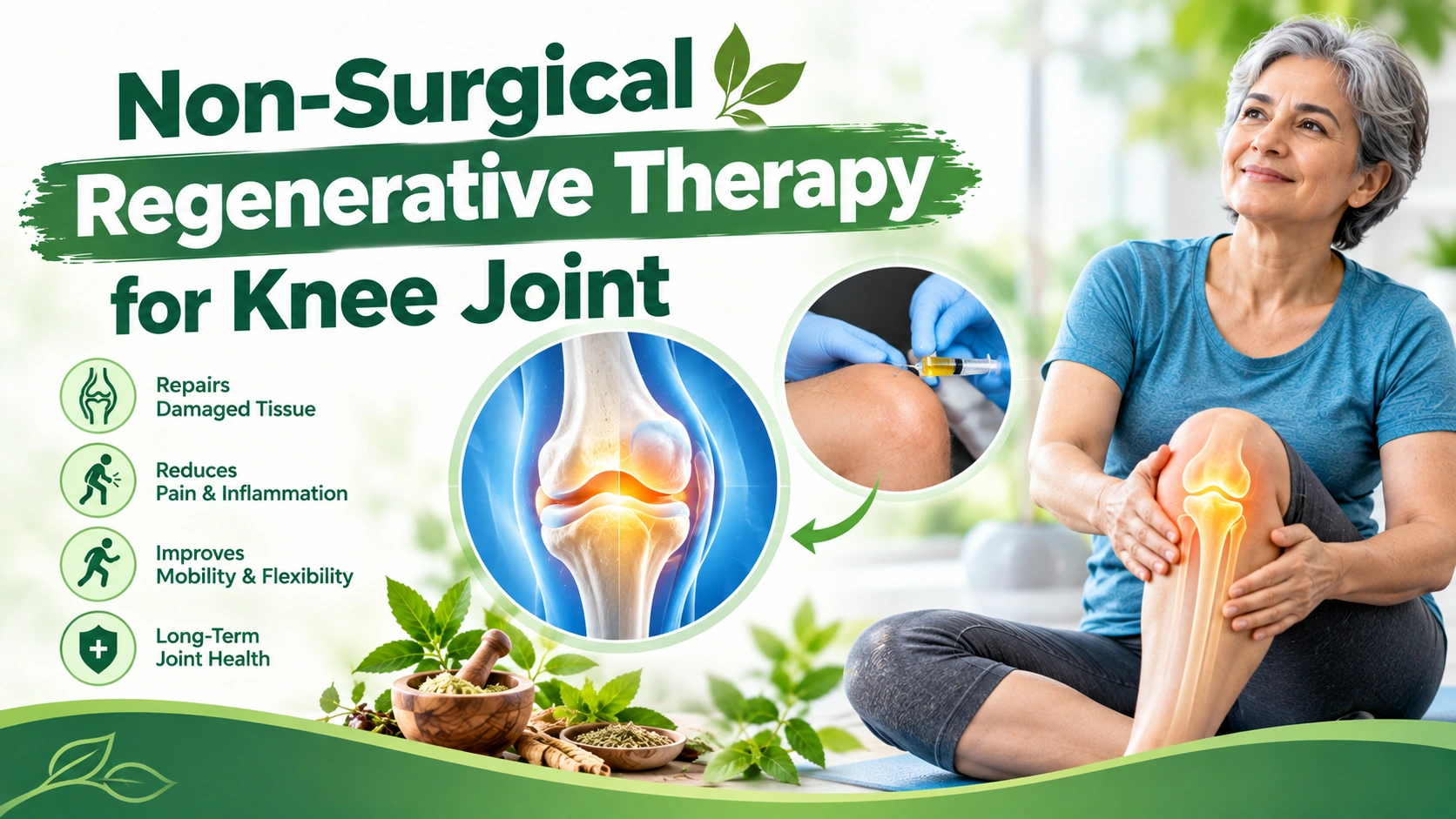
You don't need surgery for every cranky knee; most of the time, medicines, physiotherapy, lifestyle changes, and Ayurvedic treatment for knee pain can do the job first. That's basically what "conservative treatment" means: everything you try before a surgeon starts looking at your knee like it's a rusted door hinge that just needs replacing.
And look, I get it. The moment your knee starts making that weird crunchy sound going down the stairs, your brain jumps straight to "oh no, I'm going to need surgery." Mine did too, the first time. But here's what nobody tells you upfront: there's a whole lot of ground between "just ignore it and hope" and "let's cut it open." Most knees actually live comfortably in that middle zone for years, sometimes forever.
So let's actually talk through what that middle zone looks like, without the medical-textbook language.
Conservative" Doesn't Mean Doing Nothing
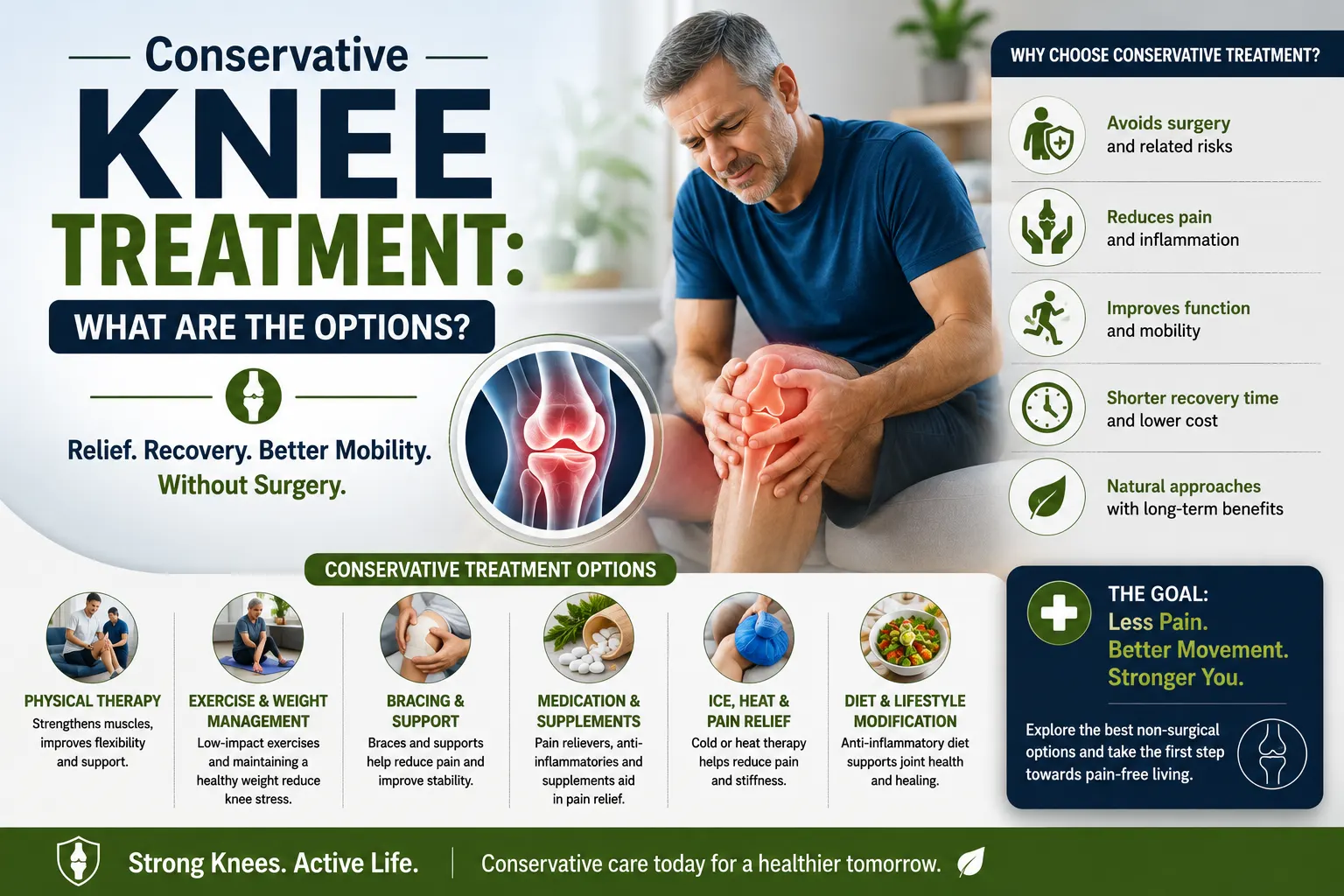
I used to think "conservative treatment" was doctor-speak for "we're not going to do much, just take it easy." Turns out that's completely wrong. It's an actual, structured plan; the only thing "conservative" about it is that nobody's picking up a scalpel. It usually includes some combination of:
- Physiotherapy and specific strengthening exercises
- Watching your weight (yes, your knees really do feel every extra kilo)
- Short courses of pain-relief medication
- Knee braces or supports
- Ayurvedic treatment for knee pain and swelling
- Small lifestyle and posture fixes that add up
None of this is glamorous. But the point isn't to look impressive; it's to cut the pain down, get your knee moving properly again, and stop things from getting worse before they need to.
Where Ayurveda Actually Fits In?
Here's what I find genuinely interesting about knee treatment Ayurveda-style: it doesn't treat your knee like some unlucky joint that just decided to betray you one random Tuesday. Ayurveda calls this condition Sandhivata, roughly the same territory as osteoarthritis in modern terms, and it links it to an aggravated Vata dosha settling into the joint, which is what causes that dryness, stiffness, and constant nagging pain.
Rather than throwing one herb at the problem and calling it a day, knee joint treatment in Ayurveda usually pulls together several things at once:
- Panchakarma therapies like Janu Basti, where warm medicated oil is pooled right over the knee using a dough boundary. Sounds odd on paper, feels genuinely soothing in practice.
- Herbal formulations meant to correct the internal imbalance, not just numb the pain
- Medicine for knee swelling in Ayurveda, often built around herbs like Guggulu, Shallaki (that's Boswellia, for the science-y folks), and Rasna
- Dietary tweaks aimed at calming aggravated Vata
- Gentle, joint-friendly yoga and movement
And no, this isn't just something your grandmother swears by with zero backing. A multicenter randomized controlled trial run in Germany, published in Osteoarthritis and Cartilage, put a full Ayurvedic treatment protocol up against standard conservative care in knee OA patients over 12 weeks, tracking results on the WOMAC index (the go-to scale doctors use for measuring OA symptoms).
The researchers ended up concluding that Ayurvedic treatment was genuinely beneficial for reducing knee OA symptoms, though they were honest enough to say more work is needed to figure out exactly which parts of the treatment were doing the heavy lifting. A follow-up look at that same trial's data, published later in the Journal of Clinical Medicine, went even further; it suggested Ayurveda might actually outperform standard conventional therapy once other factors were accounted for, and the improvements were still holding a full year late. Not exactly what you'd expect from something people sometimes wave off as "just tradition."
The Rest of the Conservative Toolkit
Ayurveda doesn't have to work solo; it plays well with others. Here's the rest of the usual lineup:
Physiotherapy. Strengthening the muscles around the knee, especially the quadriceps, takes a chunk of load off the joint itself. Basically hiring some bodyguards for your knee.
Weight management. Dropping even a handful of kilos noticeably reduces what your knee has to carry with every single step. Your future knees will genuinely thank you.
Medications. NSAIDs, topical gels, and sometimes injections like corticosteroids or hyaluronic acid, mostly for short-term relief. Useful, but they're managing the symptom, not fixing the underlying issue.
Braces and supports. Handy if there's mild instability or you need extra support during activity or sport.
Lifestyle adjustments. Fewer stairs where possible, better footwear, going easy on prolonged squatting. Small changes, but they genuinely stack up over months.
A Quick Comparison (Because Tables Make Life Easier)
| Treatment | What It's Really Doing | How Long Till You Feel It | Personality Type |
| Ayurvedic treatment for knee | Cuts inflammation, nourishes the joint, calms Vata | A few weeks to a couple of months | The patient, wise elder of the group |
| Physiotherapy | Builds up supporting muscles, restores movement | A few weeks | Your knee's no-nonsense personal trainer |
| Painkillers/NSAIDs | Fast, temporary relief from pain and swelling | Hours to a day | The friend who shows up fast then disappears |
| Weight management | Reduces day-to-day stress on the joint | Months | The slow-and-steady investment plan |
| Bracing | Adds instant external support | Right away | The reliable crutch; pun fully intended |
Talking About Swelling Specifically
Swelling is basically your knee's over-dramatic way of announcing "something in here is inflamed, please pay attention." Ayurveda tackles it from both directions; internal herbal formulations working from the inside, and external applications like Lepa (a herbal paste applied directly on the swollen area) working from the outside. That's the core idea behind most medicine for knee swelling in ayurveda; reducing the swelling without the side-effect baggage that often comes with relying on painkillers long-term.
A 2025 study protocol published in JMIR Research Protocols backed this up too, noting that several existing clinical studies have already found Ayurveda interventions to be both safe and effective for managing osteoarthritis. So, if you've been sitting on the fence wondering whether it's worth trying, that's a fairly reassuring nudge.
So When Does Surgery Actually Enter the Picture?
Conservative treatment isn't a lifetime guarantee, and it's not meant to be. If X-rays show serious bone-on-bone damage, or if you've genuinely given conservative options a real, honest try and they're just not moving the needle anymore, that's the point where talking to a surgeon starts making sense. But for a large number of people, especially in early or moderate stages, conservative and Ayurvedic routes are a legitimate first move; not a consolation prize.
Key Takeaways
- Conservative knee treatment covers physiotherapy, medication, weight management, bracing, and Ayurvedic treatment for knee issues; it's a real plan, not just "wait and see."
- Knee treatment in Ayurveda goes after the root cause, an aggravated Vata dosha, rather than only masking the pain.
- Clinical research, including a German RCT published in Osteoarthritis and Cartilage, backs Ayurveda's role in easing knee OA symptoms.
- Medicine for knee swelling in Ayurveda pairs herbal anti-inflammatories with external therapies for relief that tends to last.
- Surgery is usually the later-stage option, not the starting point.
FAQs
Is Ayurvedic treatment actually effective for knee osteoarthritis?
Yes; several clinical studies show it meaningfully eases knee OA pain and stiffness when you stick with it consistently.
How long does knee joint treatment in Ayurveda usually take to work?
Most people start noticing a real difference somewhere between a few weeks and a couple of months, since it's built around gradual healing, not overnight fixes.
Does Ayurvedic medicine for knee swelling come with side effects?
Generally, it's much gentler than long-term painkiller use, though it's always smart to check with a practitioner if you're on other medications.
Can I do Ayurvedic treatment alongside physiotherapy?
Definitely; most practitioners actually recommend combining the two, since together they tend to bring faster and more lasting results.
Will conservative treatment always help me avoid knee surgery?
Not always, but for a lot of people, especially in the early stages, it genuinely delays or completely avoids the need for surgery altogether.
Disclaimer: This blog is meant for general information only and isn't a substitute for professional medical advice, diagnosis, or treatment. Every knee is a little different, so please talk to a qualified doctor or Ayurvedic practitioner before starting any new treatment.