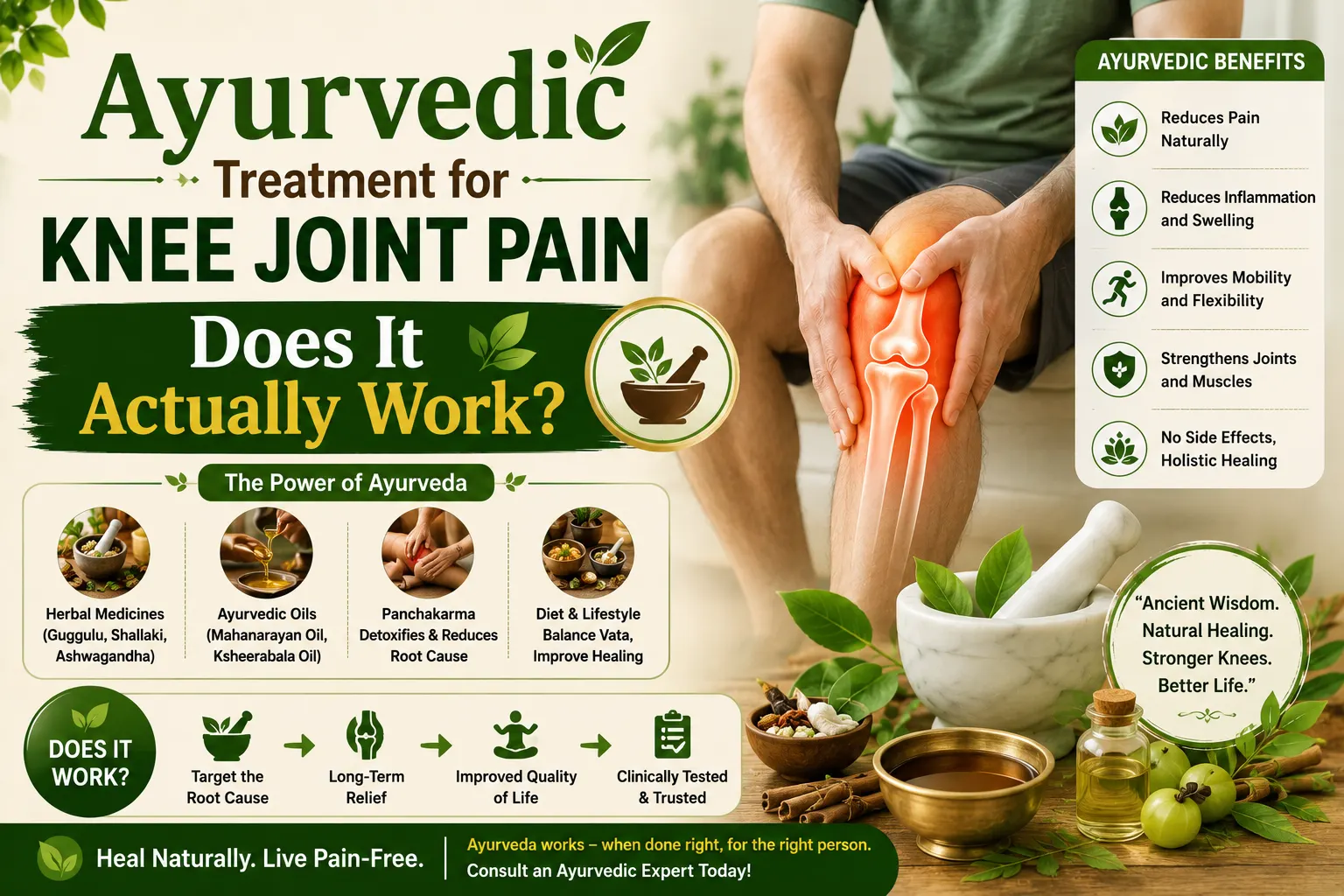
Short answer: yes, Ayurvedic treatment for knee joint pain actually helps, real talk. Herbs, oils, and a few lifestyle tweaks can genuinely calm that inflammation and get your knees moving like knees again. It won't happen in three days, though, so if you were hoping for a miracle cure between now and the weekend, I'm going to have to disappoint you a little.
🌿 Talk to Our Ayurvedic Expert Now – Get A Expert Consultation.
Delaying Treatment Can Worsen Your Condition.
👉 Call Now And Change Your Life
Okay, so here's the thing nobody tells you about knees: they don't just "get old." They start narrating their own decline. One day it's a little click when you sit down; next thing you know, you're bracing yourself for stairs like you're about to summit Everest. My uncle's knee has genuinely started sounding like a packet of chips being opened, and at this point the whole family just accepts it as background noise at dinner. Anyway. If this sounds familiar, you're not alone, and honestly, before you write it off as "just aging" and reach for the painkillers again, it's worth knowing Ayurvedic knee joint pain treatment has been quietly dealing with exactly this problem for a really, really long time. Long before anyone had heard the word "clinical trial."
So let's actually get into what works, why it works, and what science (real science, not your cousin's WhatsApp forward) has to say about it.
Why Do Knees Betray Us Like This?
In Ayurveda, most knee trouble gets pinned on something called an aggravated Vata dosha. Think of Vata as the "movement and air" energy running through your body; when it's balanced, everything moves smoothly. When it's not, it dries things out, and suddenly your joint fluid is behaving less like oil and more like sand. That's when the creaking starts.
Then there's Ama; basically leftover toxic gunk from sluggish digestion, which Ayurveda insists on blaming for half of life's problems, and honestly, it's not always wrong. Combine dried-out Vata with a bit of Ama sitting around doing nothing useful, and you get swelling, stiffness, and pain that shows up at the most inconvenient moments; usually right when you've finally gotten comfortable on the sofa.
Modern medicine has a name for most of this too: osteoarthritis. Ayurveda calls it Sandhivata. Different vocabulary, same annoying reality; and both sides agree you shouldn't just ignore it and hope for the best.
The Core Pillars of Knee Joint Pain Ayurvedic Treatment
There's no single "magic tablet" in Ayurveda, and honestly, be suspicious of anyone who tells you there is. It's more of a whole approach, several things working together. Here's roughly what that looks like:
- Herbal formulations like Guggulu-based compounds, taken orally to reduce inflammation from the inside out
- Abhyanga (oil massage) using medicated oils to lubricate the joint and improve blood flow
- Basti (medicated enemas) used in more advanced Panchakarma therapy for deep-rooted Vata imbalance
- Dietary changes that reduce Ama buildup; basically, less processed junk, more warm, easily digestible food
- Gentle movement and yoga to keep the joint from stiffening up like an old door hinge that's been ignored for a decade
The Herbs That Are Actually Doing the Work
- Guggul (Commiphora wightii); a resin, weirdly enough, with a solid anti-inflammatory reputation
- Ashwagandha (Withania somnifera); the herb everyone's been putting in everything lately, and turns out it's also decent for joint strength and stress-linked inflammation
- Shallaki (Boswellia serrata); kind of Ayurveda's answer to an NSAID, minus the stomach ache
- Rasna; an old-school pick used specifically for joint and muscular pain, not as trendy but still gets the job done
- Turmeric (Curcumin); yes, the same turmeric that's in your kitchen right now, doing double duty as a spice and a joint-pain fighter
Okay But What Does the Actual Science Say
Fair question. Because "trust the process" only gets you so far when your knee is genuinely hurting.
There's a study published in the Journal of Ayurveda and Integrative Medicine that looked at 142 people with knee osteoarthritis, giving them a combo of Vatari Guggulu, Maharasnadi Kwatha (an herbal decoction), and Narayan Taila (a massage oil) for 12 weeks straight. Pain scores and WOMAC scores; that's the standard measure doctors use for how bad osteoarthritis actually is; dropped in a way the researchers called statistically significant. Not a small dip. A real one.
Then there's a bigger one; a multicentric study run across 14 institutes under the Central Council for Research in Ayurvedic Sciences, involving close to 500 participants with knee OA. They were given Yograj Guggulu, Ashwagandha Churna, and Narayana Taila for 12 weeks, and the researchers found it well-tolerated and genuinely effective at easing the core symptoms people struggle with.
On the turmeric side of things, a randomized controlled trial in Phytotherapy Research pitted a turmeric-black pepper-ginger blend directly against Naproxen, a common anti-inflammatory drug, for chronic knee osteoarthritis. The herbal blend basically held its own; comparable results, no big drop-off.
And a more rigorous randomized controlled trial published in Complementary Therapies in Medicine tested individualized Ayurvedic treatment (Ashwagandha and Yogaraja Guggulu included) against regular conventional care, and found meaningful improvement on the Ayurveda side.
So no, this isn't just folklore your grandmother swears by (though, credit where it's due; she was right this whole time). It's stuff that's actually been through the same kind of scrutiny modern medicine puts everything through. Doesn't mean you cancel your doctor's appointment, though. It means there's a legitimate second tool in the box.
Ayurveda vs the Usual Doctor's-Office Route
Let's be honest about both sides for a second, because neither one is perfect and anyone telling you otherwise is selling something.
| Factor | Ayurvedic Treatment | Conventional Treatment |
| Speed of relief | Slow burn, tortoise energy | Fast, hare-with-a-painkiller energy |
| Side effects | Usually mild if done right | Stomach issues, dependency risk over time |
| What it actually targets | Digestion, lifestyle, root imbalance | Mostly just the symptom in front of it |
| Effort required from you | A fair bit; oils, diet, patience | Barely any; swallow, repeat |
| Cost down the line | Tends to even out cheaper | Adds up with every refill |
Basically, conventional treatment is grabbing an umbrella because it's already pouring. Ayurveda is more interested in figuring out why it keeps raining on your knees specifically. Both have their place, honestly; this isn't a "pick a side" situation.
Stuff You Can Just Start Doing at Home
- Warm sesame oil massage on the knees before your bath; five minutes, that's it
- Slow, gentle yoga like Setu Bandhasana (bridge pose); don't rush it, this isn't a workout
- Cutting back on cold, raw, overly processed food, since Ayurveda blames a lot of this on Ama buildup, and honestly your gut probably agrees
- Sticking with it; this is a marathon thing, not a "do it twice and quit" thing
- Warm fomentation on those extra stiff mornings, especially in winter
Quick Recap Before You Go
- Ayurvedic treatment for knee joint pain goes after both the symptom and the root cause: Vata imbalance and Ama buildup
- Guggul, Ashwagandha, Shallaki, and Turmeric all show up in real clinical studies, not just tradition
- Knee joint pain Ayurvedic treatment works best as a full routine; herbs, oils, diet, movement; not a single bottle you take and forget
- Multiple trials show actual, measurable drops in pain and WOMAC scores with Ayurvedic protocols
- It takes weeks, not days, so don't quit after four days because "nothing's happening"
Questions People Actually Ask
Is Ayurvedic treatment for knee joint pain effective for osteoarthritis?
Yes, several clinical studies show meaningful reduction in pain and stiffness with consistent Ayurvedic protocols over 8-12 weeks.
How long does knee joint pain Ayurvedic treatment take to show results?
Most people notice gradual improvement within 4 to 12 weeks of consistent herbs, oils, and dietary changes.
Can Ayurvedic knee joint pain treatment be combined with regular medication?
Generally yes, but it should only be done under the guidance of both your doctor and an Ayurvedic practitioner to avoid interactions.
Which Ayurvedic herb is best for knee pain?
Guggul, Ashwagandha, and Shallaki are the most researched herbs, often used together rather than alone for better results.
Is oil massage really necessary for knee pain relief?
Yes, regular warm oil massage improves circulation and joint lubrication, making it one of the simplest and most consistent parts of the routine.
Disclaimer: This blog is for general informational purposes only and is not a substitute for professional medical advice, diagnosis, or treatment. Please consult a qualified doctor or registered Ayurvedic practitioner before starting any new treatment for knee joint pain, especially if you have an existing medical condition.