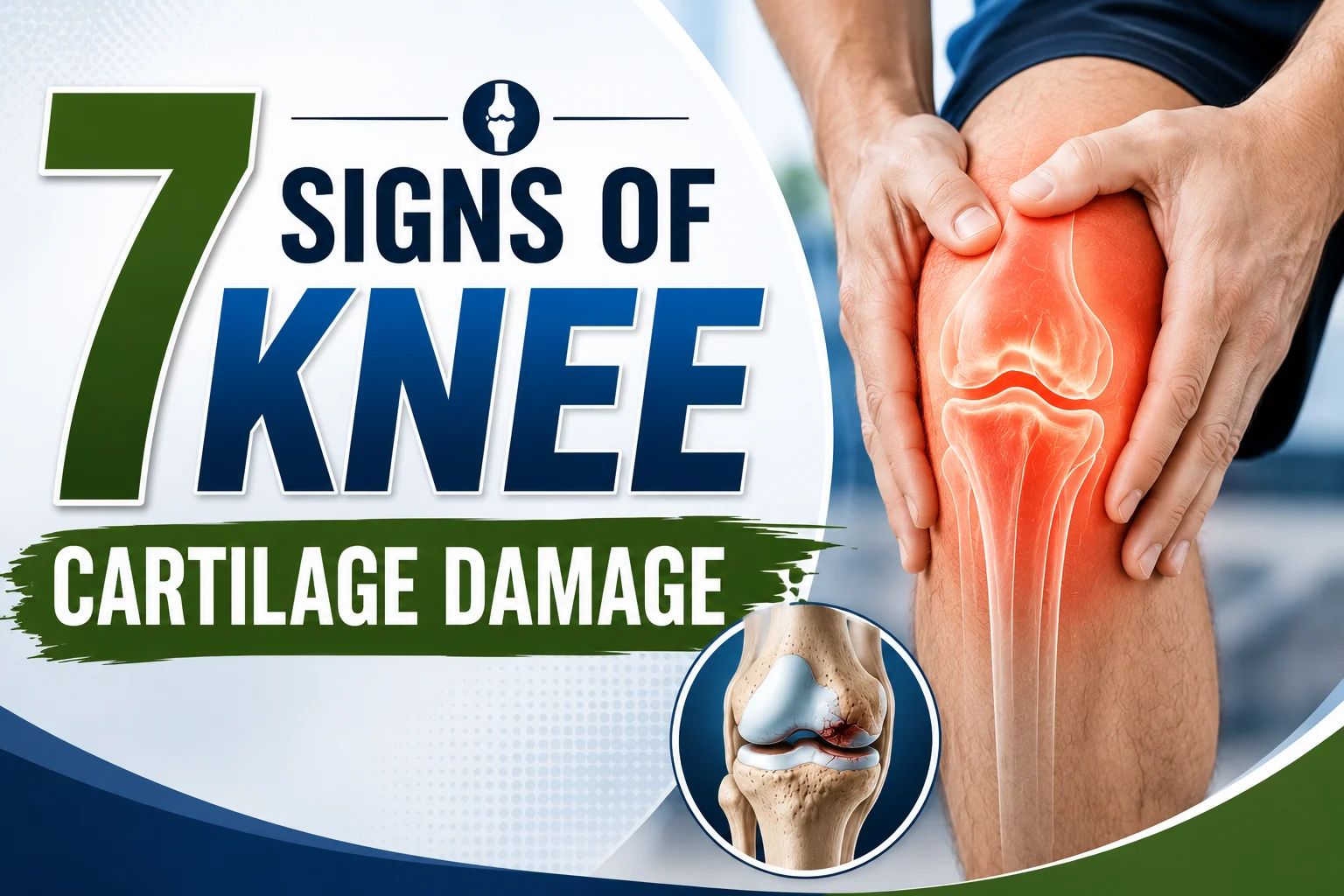
7 Signs of Knee Cartilage Damage (Because "It's Probably Nothing" Isn't a Diagnosis)
Short answer: pain that won't quit, swelling, a clicky/grindy knee, stiffness (especially in the morning), that awful "my knee just gave out" feeling, locking up mid-step, and losing your range of motion. Those are the seven. If you read that list and went "oh no" at even two of them, stick around; we're going to actually talk about knee cartilage damage instead of just Googling your symptoms at 1 am and diagnosing yourself with something terrifying.
I'll be honest, most of us treat our knees like background employees. They show up, they do the job, nobody claps. You don't think about your knees until the day you crouch down to grab something off the bottom shelf and there's this... crunch. And a small internal scream. That's usually when people start typing "why does my knee sound like Rice Krispies" into a search bar.
So let's get into it; what's actually going on under there, and how to tell "eh, I'm just getting older" apart from "okay this might actually be cartilage wear and tear."
1. Pain that doesn't take a hint
Normal soreness; the kind you get after leg day or a long hike; usually calms down after a night's sleep and some stretching. Cartilage-related pain is not like that. It lingers. It shows up when you're climbing stairs, or squatting, or just kneeling down to tie your shoe, and sometimes it just sits there as a dull ache even when you're doing absolutely nothing, which honestly feels unfair.
Here's why: cartilage is basically your bone's cushion. Wear it down and you've got less padding between two surfaces that were never meant to touch directly. More friction, more irritation, more "why does this hurt for no reason." And you're far from alone here; the NIH has noted that roughly a third of American adults over 45 deal with some form of knee pain. So no, it's not just you being dramatic.
2. Swelling that shows up like an unwanted party guest
Swelling is basically your knee's way of putting up caution tape. Cartilage damage triggers inflammation, and depending on how bad things are, that can look like:
- A little puffiness after you've been on your feet all day
- A knee that's warm to the touch and tender when you press it
- In worse cases, a joint that genuinely looks a bit swollen and shiny, like it's storing water for winter
Mild and occasional in the early stages, more stubborn and constant as things get worse.
3. The clicking, grinding, popping thing
Doctors call this crepitus. Normal people call it "why does my knee sound like a bag of chips." It happens because cartilage that used to be smooth has gotten rough and uneven, so instead of gliding quietly, your joint now makes noise every time you bend it.
Now, before you panic; a random pop here and there, with zero pain, isn't automatically a disaster. Knees do that sometimes for no dramatic reason. But grinding that comes paired with pain, swelling, or that classic "something feels wrong in there" sensation is worth actually getting looked at.
4. Stiffness, especially in the morning
You know that feeling where you get out of bed, and your knee needs a solid five minutes before it's willing to cooperate? That's stiffness, and it's one of the more common early signs people brush off because, well, everyone's a little creaky in the morning, right? Except with cartilage damage, it doesn't really go away once you're "warmed up"; it just gets a little more bearable.
5. The knee-giving-way feeling
This one's genuinely unsettling the first time it happens. You're walking, totally normal, minding your business, and suddenly your knee just... doesn't feel trustworthy. Like it's about to buckle underneath you. Sometimes it actually does.
This happens because damaged cartilage messes with how weight moves through the joint, so your knee's usual sense of "I've got this" gets a little scrambled.
6. Locking or catching
Occasionally a bit of damaged cartilage breaks off and floats around inside the joint; imagine a tiny pebble stuck in your shoe, except it's inside your knee and you can't just take your shoe off to fix it. When it gets caught wrong, your knee can lock up completely or refuse to straighten, usually followed by you standing there awkwardly like a broken action figure.
7. Losing your range of motion
Slowly, over time, you might notice you just can't bend or straighten your knee the way you used to. Sitting cross-legged becomes a negotiation. Squatting to pick something up turns into an event. This gradual stiffening is often a sign that things have moved past "minor annoyance" territory into something that actually needs attention.
Okay, but does the research back this up?
Yes, actually. This isn't just knee folklore passed down from your uncle who "knows a guy." A study published looking at knee cartilage damage in people who had no symptoms at all (Riddle et al., published via NIH/PMC) found that people with a BMI of 25 or higher had roughly three times the odds of having significant cartilage damage compared to people with a normal BMI. Which means damage can quietly be happening before your knee even bothers to complain about it; kind of rude, honestly.
There's also a decent chunk of orthopedic research connecting repetitive high-impact activity; running, jumping sports, old injuries that never fully healed; with a higher long-term risk of cartilage breakdown, which eventually can turn into osteoarthritis. Think of osteoarthritis as cartilage damage's grumpier, more permanent older sibling.
Regular Achy Knee vs. "Maybe I Should Get This Checked" Knee
| Thing | Just Sore | Possibly Cartilage Damage |
| How long it sticks around | Gone in a day or two | Weeks, comes and goes, annoyingly persistent |
| Sound effects | None, blissfully silent | Clicks, pops, occasional crunch |
| Swelling | Rare, mild if any | Shows up repeatedly, sometimes warm |
| Trust level | Full trust, no issues | Occasionally "ghosts" you mid-step |
| Mornings | A little stiff, fine after a stretch | Stiff for a while, needs a proper warm-up |
Key Takeaways
- Ongoing knee pain that doesn't ease up with rest is often the first real clue something's off with your cartilage.
- Swelling, stiffness, and that clicky/crunchy sound (crepitus) are all common early warning signs worth noticing.
- A knee that locks, catches, or buckles underneath you is a bigger red flag than the others; don't just walk it off.
- Research links higher BMI to significantly higher odds of cartilage damage, even in people who feel totally fine.
- Catching knee cartilage damage early usually means simpler treatment and way less hassle down the road.
- If in doubt, get it looked at. Knees are a one-per-leg situation, no replacements included at checkout.
Wrapping this up
Your knees have quietly carried you through a lot; every set of stairs, every awkward parking-lot jog to catch a green light, every time you crouched to pick up something you dropped. So when they start clicking, swelling, seizing up, or giving out on you mid-walk, that's nothing. It's worth actually paying attention instead of just icing it and hoping it sorts itself out. Catch signs of cartilage damage early, and you generally give yourself way more options and a much shorter recovery road. So next time your knee starts sounding like a cereal bowl, maybe don't just turn up the TV.
FAQs
Can knee cartilage damage heal on its own?
Not really, cartilage barely gets any blood flow, so it heals slowly at best, though mild cases can improve with rest and the right strengthening exercises.
Is a clicking knee always something serious?
Nope, painless clicking is usually harmless, but if it comes with pain or swelling, get it checked.
What's actually the difference between cartilage damage and arthritis?
Cartilage damage is often the starting point, and osteoarthritis is basically what happens if that damage keeps going unaddressed.
Does carrying extra weight really mess with your knee cartilage?
Yes, studies have tied a higher BMI to a noticeably higher risk of cartilage damage since your knees are carrying more load with every step.
At what point should I actually go see a doctor about this?
If pain or swelling sticks around for more than a couple weeks, or your knee starts locking or buckling on you, that's your cue to stop guessing and get it checked.
Disclaimer: This article is meant for general information only and isn't medical advice. It can't diagnose what's going on with your knee, so if you're dealing with ongoing pain, swelling, or instability, please talk to an actual doctor or orthopedic specialist instead of trusting a blog post.